
Ideation of Screens on Figma
I learnt to use APIs and integrate ChatGPT into the functionality of the app, and also learnt to use Firebase. I realised that there is a lot that goes behind the scenes of a simple app, and I am more appreciative now of apps which seamlessly allow you to use them and present their functionality intuitively.
Translating certain ideas to actual development was tough, and I had to modify the proposed functionality of the app accordingly. As I was trying to develop two flows for two different user categories, I had to use boolean variables and conditional prototyping to present the app differently based on the user category.
Thunkable is a useful software to understand how your app should work, but doesn’t allow for complex functions or design.
At the same time, while Figma will allow for a much better UI and possible UX, it would be tough to implement a lot of the data-dependent functions.
Learnings and Reflection


What Are Our Daily Interactions With The Constitution?
Stakeholders Meeting
Prototyping on Thunkable
Ideation of Screens on Figma
The Insights
How does privilege (or lack thereof) impact the citizens’ awareness of the constitution and the values it imparts?
The lack of awareness of privilege works both ways - the privileged have no need to know their constitutional rights or values as they aren't really affected, and the underprivileged don't know that their rights aren't being honoured in the first place, which leads to this perpetuating cycle of misinformation and a lack of awareness.
And it’s not just a lack of awareness, it is a real lack of trust in the real life presence of those rights. Rights that cannot be ensured are in many circumstances rights that don't exist. Then comes the many legally grey actions that we all perform knowing that our rights are not fully guaranteed.
This leads back to the question - are certain rights not being ensured due to a lack of awareness? Or just a lack of care/discrimination/something along those lines?
Are unconstitutional laws passed because people don’t care about constitutional values, or because they don’t know how these values would be applied to the law?
The legalese is indeed part of the problem. But it's in general a sense of distance from the Parliament. The Parliament/legislature and its workings are restricted by language and digital media. Unconstitutional laws exist because the majority in the parliament believes in them. The Supreme Court also has its biases.
In an ideal world, it wouldn’t work this way. The government would not be a symbol of control and censorship. There are different ways of ensuring fair representation. Our electoral system itself puts our country at a disadvantage. We use a first-past-the-post system where 70% of the votes could have gone to 20 different parties with similar ideologies, but the party with 30% votes will win. 70% of the votes are ignored! It is not a democracy for the majority, but rather a democracy for the majority that could go organise itself.
Primary Research
Interviewing people around me from various demographics on their opinions on the constitution and whether they were aware of their values or not
People from college
An individual who works at LSEG (London Stock Exchange Group)
A retired English professor
A high school student
Talking to an expert, Adhavan, who developed the Constitutional Observer and works with Alt Law Forum
Fundamental Rights and Duties
Freedom of Speech: People express their opinions, whether on social media or in conversation, which is protected under Article 19 of the Constitution.
Equality: Daily interactions, such as access to public services and employment opportunities, are shaped by constitutional guarantees of equality (Article 14).
Religious Freedom: The right to practice and propagate one's religion is exercised regularly, rooted in Articles 25-28.
Fundamental Duties: While less talked about, duties like respecting national symbols or protecting public property are part of daily life.
Legal Frameworks
Laws and Regulations: Everyday activities, from paying taxes to following traffic rules, are governed by laws derived from constitutional principles.
Judicial Access: When seeking justice or addressing grievances, people engage with the legal system, which operates under the framework set by the Constitution.
Government Services and Benefits
Public Services: Access to healthcare, education, and social welfare schemes are provided as part of the state’s responsibility, which is constitutionally mandated.
Secondary Research
Listening to podcasts by Alt Law Forum, reading the book The Preamble: A Brief Introduction
Reading A People’s Constitution: The Everyday Life of Law in the Indian Republic
Using the Constitutional Observer (https://constitutional.observer/)
Regular User
Can learn fun facts about the Indian legal system on the home page.
Can view FAQs
Can post queries to a community forum for legal experts to answer
Can locate lawyers/legal experts based on their location
Can chat with Ambi, the AI assisted chatbot

Legal Expert
Has to get verified first by disclosing their educational qualifications as well as experience; must be certified by AIBE
Can answer questions on the community forum
All other actions available to regular users
Has a slightly modified home page (has an indication that they are a legal expert)

Empower Legal: The App
Takeaways
User Categories
A non profit organisation run by people well versed with the law
Empowers people from all backgrounds to learn more about their rights, duties and the fundamental values that the Constitution defines
Enables users to connect with advocates who can answer their legal queries on priority
Feature to book or consult a public defendant/advocate to represent their best interests
Feature to receive news on the Constitution, updates and amendments of laws, protests, etc.
To further develop and refine our ideas, we broke into groups and conducted mock stakeholders meetings. This was crucial to the ideation of the app, and provided very useful perspectives and feedback.
For my stakeholders meeting, I served as the UX researcher, and my peers played the roles of CEO & Project Lead, Government Representative, and two different user personas.

Only verified people can answer community questions - rigorous process to get verified
Main concern is education and literacy - scope of app does not extend to help people during crises. App is not a replacement for the police
Will have to be as unbiased as possible - will try to get all perspectives and people from all wings to answer questions
Will try and partner up with different clinics and different bodies, so will have firsthand access to any new info and interpretations of the info itself
Language will be simple with no jargon, easy to understand for everyone. Translations will be provided to local languages
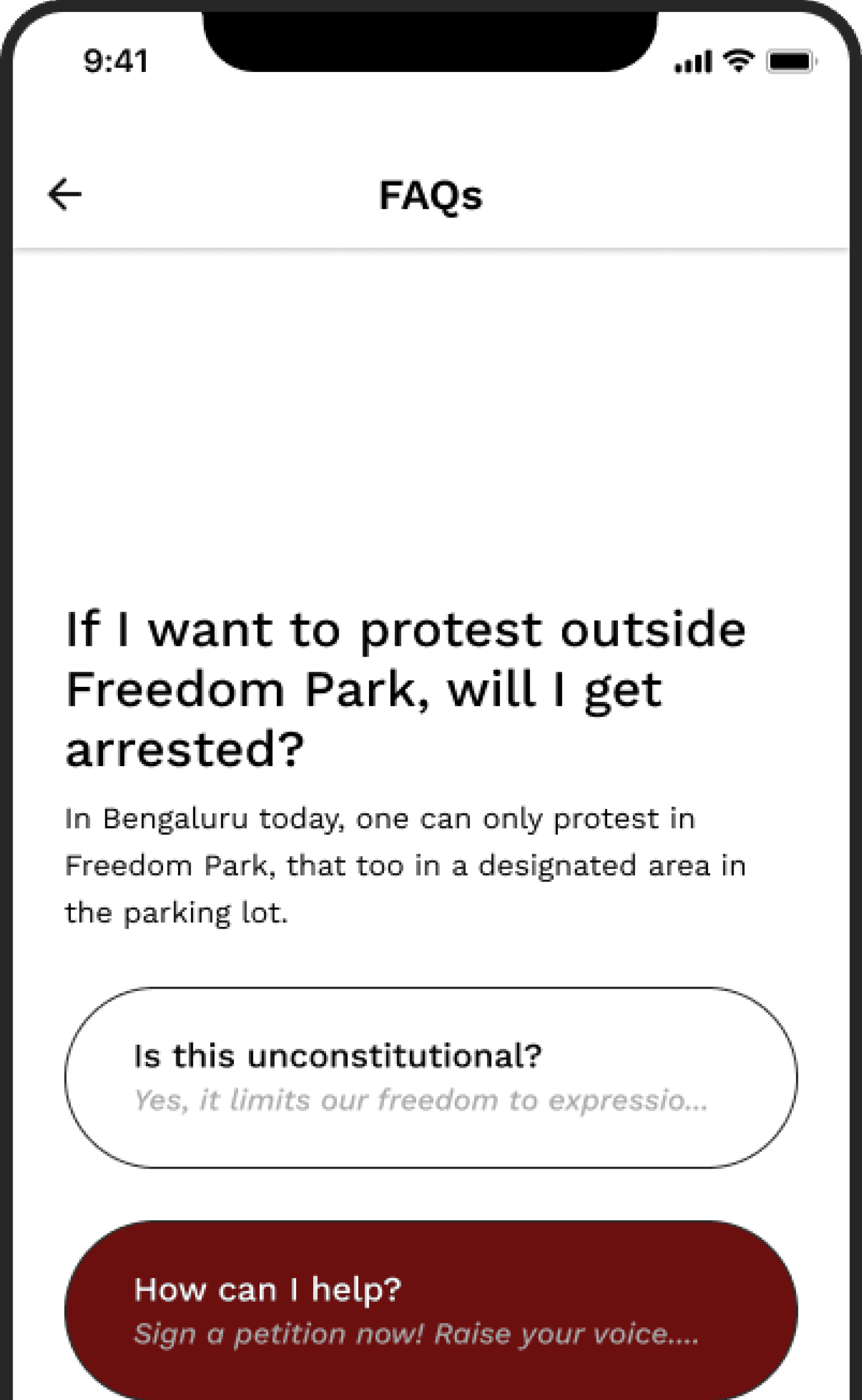
Who is putting the legal information up?
Are they qualified/certified by bar association?
Is the information on the app up to date?
Are you sure the user will interpret the info correctly?
Will you stay unbiased and not comment on current political events?
How will you avoid censorship (read above)
Are you partnering up with the Department of Justice/any other government department that deals with legal literacy? (Legal Services Authority Act, National Legal Literacy Mission)


If I have a problem, my first instinct is to call the police
I’d want easy language, wouldn’t understand jargon
I would want in the language I’m comfortable in
Would like to connect to a legal expert without having to pay
FAQs have a sense of disconnection - is anyone listening to me?
I would like a chatbot
If I look up a law/act, I want real world examples of how it has been implemented
An interactive feature would be nice - something gamified?
Just reading interpretations of various laws/acts might get very boring or monotonous
I'd like to get a summarised version if I want to look a law up
Want simple language, no legal jargon


User A
Use Case: Seeking Help
User B
Use Case: Education

Humans are putting information out there and they always come with their own bias - how can we have the information remain unbiased?
Who will take accountability for actions taken by users after taking information from the app?
How do you convince lawyers to put info/answer legal questions on a platform - they have to have accountability but also cannot control users actions
How much legal trouble will the founder/CEO get into if something goes wrong?
Maintain balance between giving information and forcing opinions
Blog might get too overwhelming for users - solution is good SEO, use a lot of keywords
Chats can be recorded to maintain accountability - similar to how 911 calls are tracked


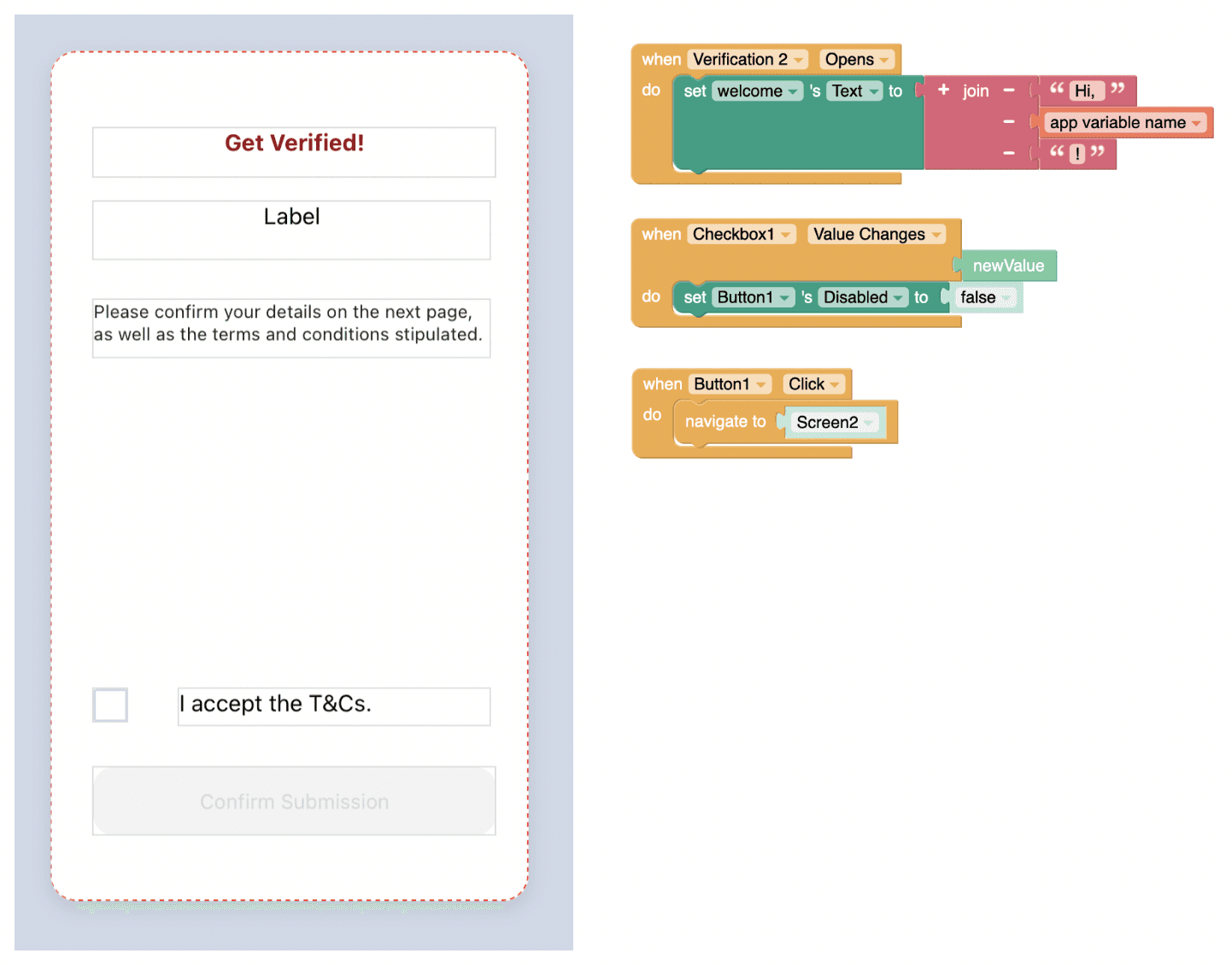
With Thunkable, it was easy to figure out the logic behind the functionality of the app - when should a certain button be enabled, what data set is a specific command drawing information from, where is the user’s data being stored, and so on. Using this software, I also integrated GenAI with the app, creating a simple chatbot that users can ask their queries to.
Watch the app in action here!
Thank you for scrolling :)
If my work interests you, please feel free to get in touch. Let’s make magic!
Resume
Empower.
Research
Business Design
Prototyping
The aim of this project was to develop an app that would promote legal literacy for people from all backgrounds in India. It enables users to connect with advocates who can answer legal questions on priority, and promotes community learning.
4 week studio
Solo project
Why Empower?
The Constitution is founded in the fact that it is ‘we the people’ who ‘adopt, enact and give to ourselves’ this Constitution. Unfortunately, in the present, the people of our country remain largely unaware of the values defined in the Constitution, as well as the duties that are outlined in it.
After interacting with members from #ReclaimConstitution and Alternate Law Forum, I realised that I come from a privileged background which doesn’t require me to be aware of what the constitution entails w.r.t rights and duties. I wanted to educate myself!
I wanted to understand how society would be different (politically, socially and culturally) if people were aware of the values that this country was built in mind with. What is stopping us from embracing and building on our constitutional values to aid in the social development of this nation?
How Did I Conduct Research?